Here, I continue listing shrubs that bloomed in my hedgerow each week during the spring of 2024. With the cooler spring we’re having so far in 2025, I expect everything to bloom later this year.
Before I begin, I want to mention a few resources for planning your own hedgerow. The Ottawa Field Naturalists’ Club page, Creating a hedgerow for wildlife, includes general guidelines for creating hedgerows, as well as lists of suitable native shrubs for sun and shade. Since most information about hedgerows is from the UK or the States, it’s great to find something local. Recently, I found another helpful article by the Peterborough Master Gardeners, Creating a wildlife friendly hedgerow in my Ontario garden.
To see an example of a mature hedgerow of native shrubs in Ottawa, you can visit the Canadian Wildlife Federation office in Kanata. Their grounds are open to the pubic and you can view a variety of plantings all around the building (see the Wild Pollinator Partners blog post, Touring the Canadian Wildlife Federation demonstration gardens). Sadly, the hedgerow near Fletcher Wildlife Garden, created by the Ottawa Field Naturalists’ Club, was removed several years ago to make way for a baseball diamond.
May 19 to 25: Red Osier Dogwood, Nannyberry Viburnum
Toward the end of May, my Red Osier Dogwoods and Nannyberry Viburnums were in full bloom. Red Osier Dogwoods are one of my favourite shrubs (see my blog post Red Osier Dogwood: a perfect four-season shrub). The ones pictured here are now in a fair bit of shade, but they continue to bloom and produce fruit. Admittedly, the ones in full sun are more productive and grow in a more compact form.
My most mature Nannyberry Viburnum is also now in a lot of shade. They apparently need several others nearby to produce fruit; I haven’t seen berries yet because my other Nannyberries aren’t big enough to have flowers. The CWF demonstration garden has a nice stand of Nannyberries that were full of green, and American Robins eating the unripe fruit, when I visited last July.
Although I don’t see many pollinators visiting Red Osier Dogwood flowers, I did see a lot on the Nannyberry flowers.
This week, the Bladdernuts, Limber Honeysuckles, Fragrant Sumasc, and Pagoda Dogwood continued to bloom.
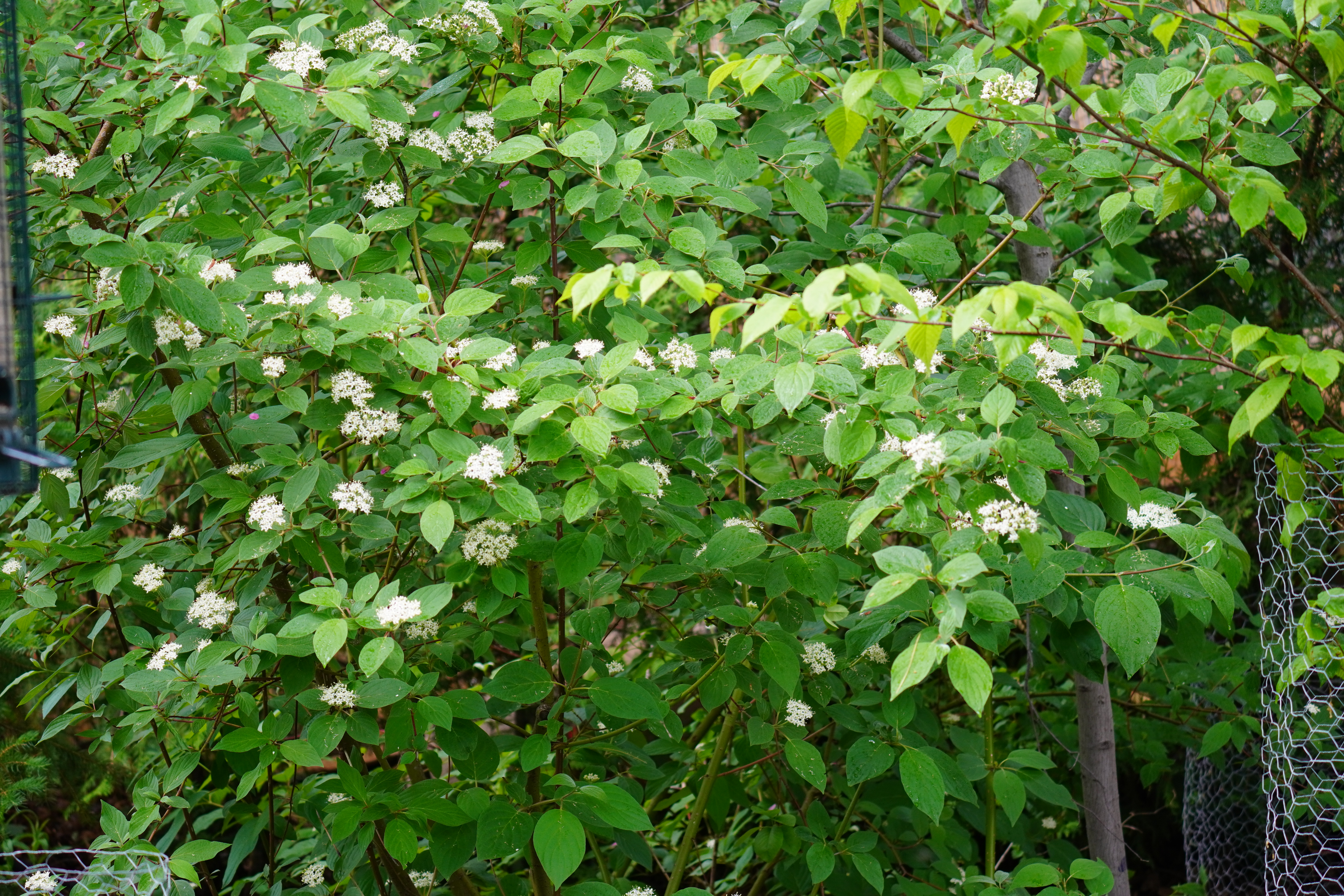

Photo 1. 2. Red Osier Dogwood in full bloom (May 21, 2024); Solitary bee on a Nannyberry Viburnum flower cluster (May 25, 2022).
May 26 to June 1: Wild Raisin Viburnum, unknown raspberries
The Red Osier Dogwoods and Nannyberries continued to flower.
By the pond, I have a cluster of dwarf ‘Lil Ditty’ Wild Raisin Viburnums. I bought them before I knew that cultivars are less desirable that straight species versions. Nevertheless, their short, compact form makes them a good choice for the front of my pond-side bed. Their flower clusters are very attractive to bees seeking nectar and pollen.
My cultivated raspberry bushes were also blooming prolifically. The Cottontail rabbit(s) ate my native black raspberry canes, so I can’t say if they would have bloomed at the same time. These insignificant flowers attract an astonishing variety of pollinators. Despite their pollinator value and tasty fruit, raspberries spread too aggressively for an urban yard. While I don’t mind them in the hedgerow, I curse their prickly canes that pop up elsewhere.


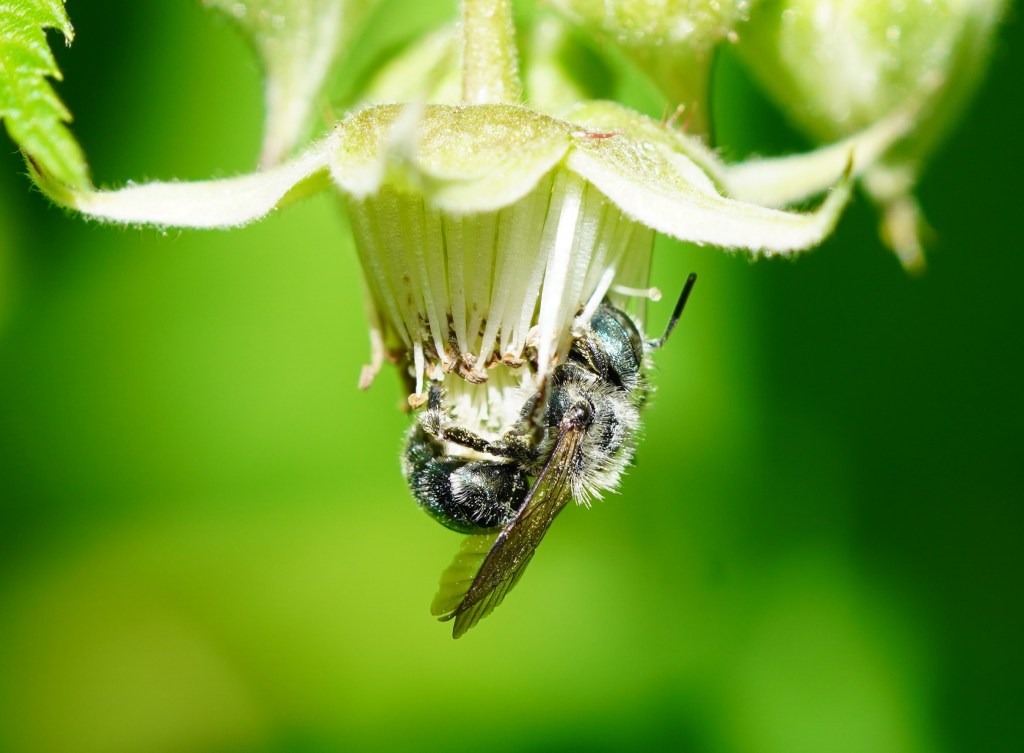
Photos 1-3: Wild Raisin Viburnum cultivar ‘Lil Ditty’ (June 7, 2020); 4 and 5: a bumblebee and a solitary bee on cultivated raspberry flowers (June 7, 2022).
June 2 to 8: Hop Tree, Hairy Honeysuckle
This week, the Hop Trees were in full bloom. What a beautiful fragrance! I’m surprised they aren’t more widely planted because they’re tough, small trees with such a lovely smell and attractive seed clusters. Hop Trees aren’t a local native species, but do grow in Southwestern Ontario. I planted them because they’re a host plant for Giant Swallowtail butterflies, and they’re better suited to an urban garden than Prickly Ash, the host plant that grows in our region.
Here’s another vine that is rambling over shrubs in my hedgerow — Hairy Honeysuckle. In 2024, they bloomed better than ever before, perhaps because of all the rain, The flowers actually change from yellow to orange as they age.
Since it’s so hard to find Limber and Hairy Honeysuckle vines for sale, I tried to propagate them from cuttings. Only a few survived. I will do some more research and try again this summer.
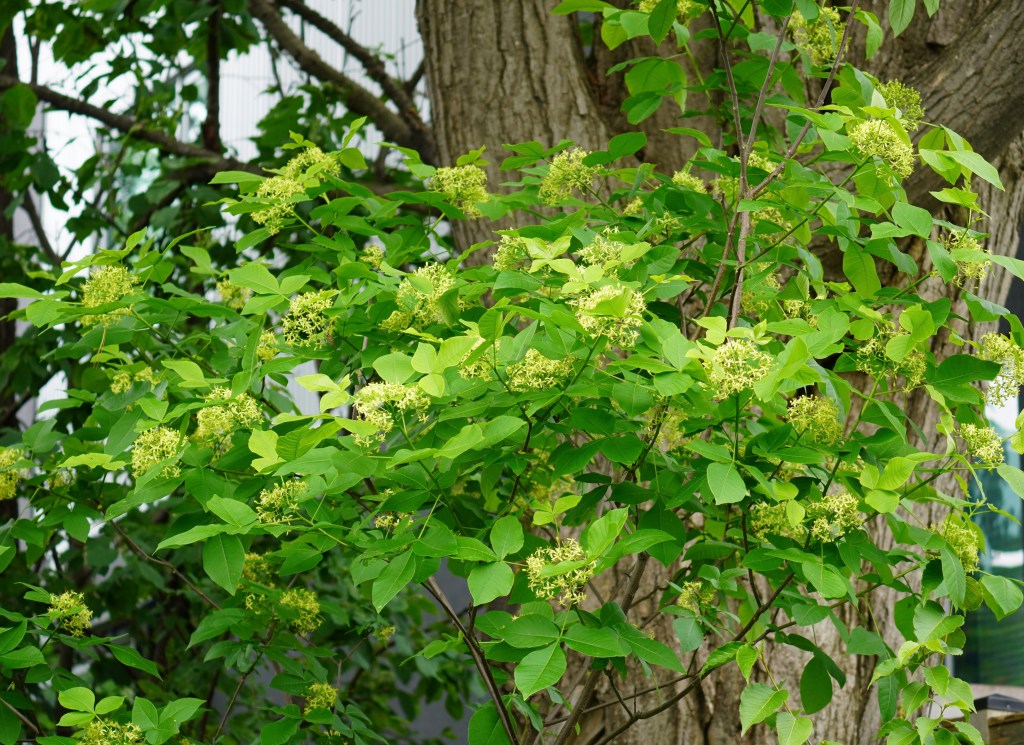


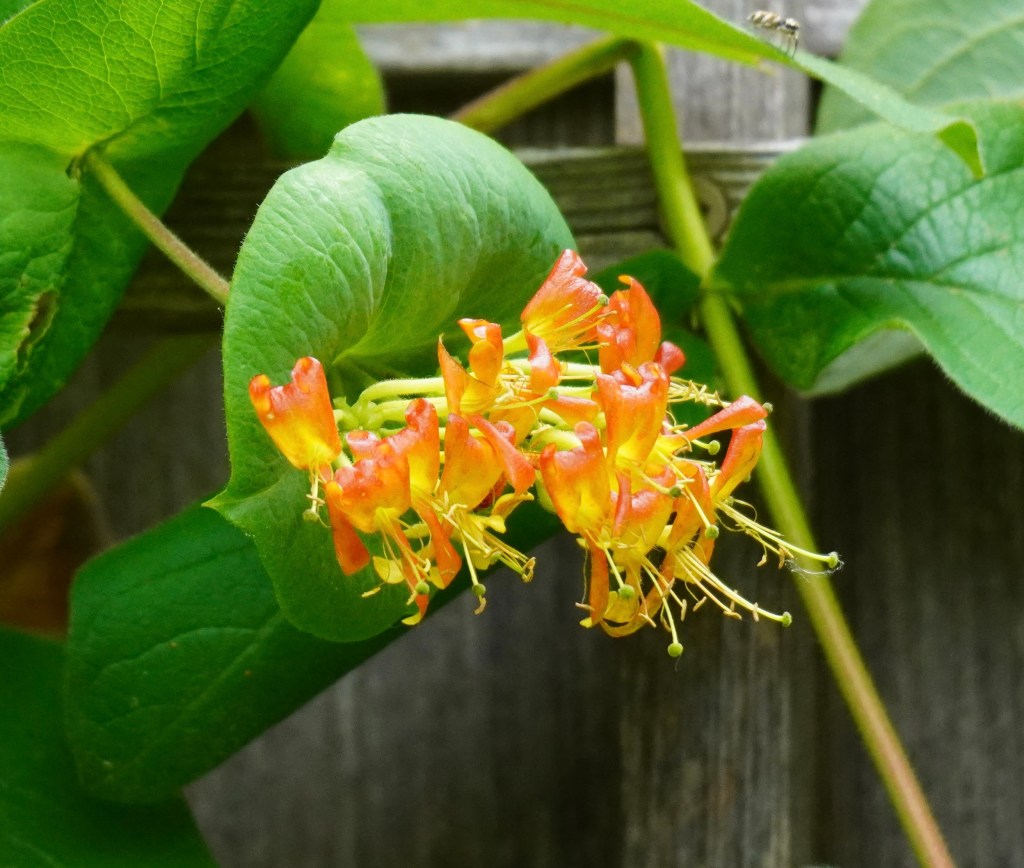
Photo 1: One of my Hop Trees in full bloom (June 10, 2024). The last 3 photos show my oldest Hairy Honeysuckle vine on a trellis. The flowers were yellow on June 5, 2024, and orange by June 12, 2024.
June 9 to 15: Black Elderberry, Gray Dogwood, Winterberry, Smooth Rose, Snowberry
This week, there was another big flush of blooms in the hedgerows; Black Elderberries, Gray Dogwoods, Smooth Rose, and Winterberry were all in flower.
The Elderberry flower clusters looked like side plates balanced on branches. Oddly, I can’t find any photos of pollinators on these flowers, even from past years. I don’t know if it’s because few insects visit them, I just didn’t notice them, or I didn’t bother to take photos. They produce abundant berries though, so something is visiting the blooms.
I have to say that I regret planting Gray Dogwoods. While they have high wildlife value, they’ve suckered so much that I wouldn’t recommend them for urban yards. I’m resigned to cutting suckers every year now. At least they do produce a lot of flowers and fruit. Red Osier Dogwood and Pagoda Dogwood are more ornamental and better behaved, making them better choices.
I also noticed that my relatively new Smooth Rose bushes were sporting pretty pink blooms favoured by bumblebees. I’ve now learned that these sucker a lot too, so I hope they don’t become a nuisance.
The Winterberries were covered in tiny white flowers visited by even tinier pollinators. I have 4 females and 1 male that I bought as quite mature plants. They were fruiting in the nursery so I could tell which ones were female because they were the ones with fruit. My conditions really aren’t wet enough for them, so they don’t produce much fruit in my yard. However, 2024 had an exceptionally rainy growing season, and my shrubs finally produced lots of scarlet berries.
My new Snowberry shrubs were covered in tiny pale pink bells. Unfortunately, I’m not sure if I have are the local, eastern Common Snowberry or the invasive Western Snowberry. My shrubs aren’t very old, so they should be easy to remove if they turn out to be undesirable.
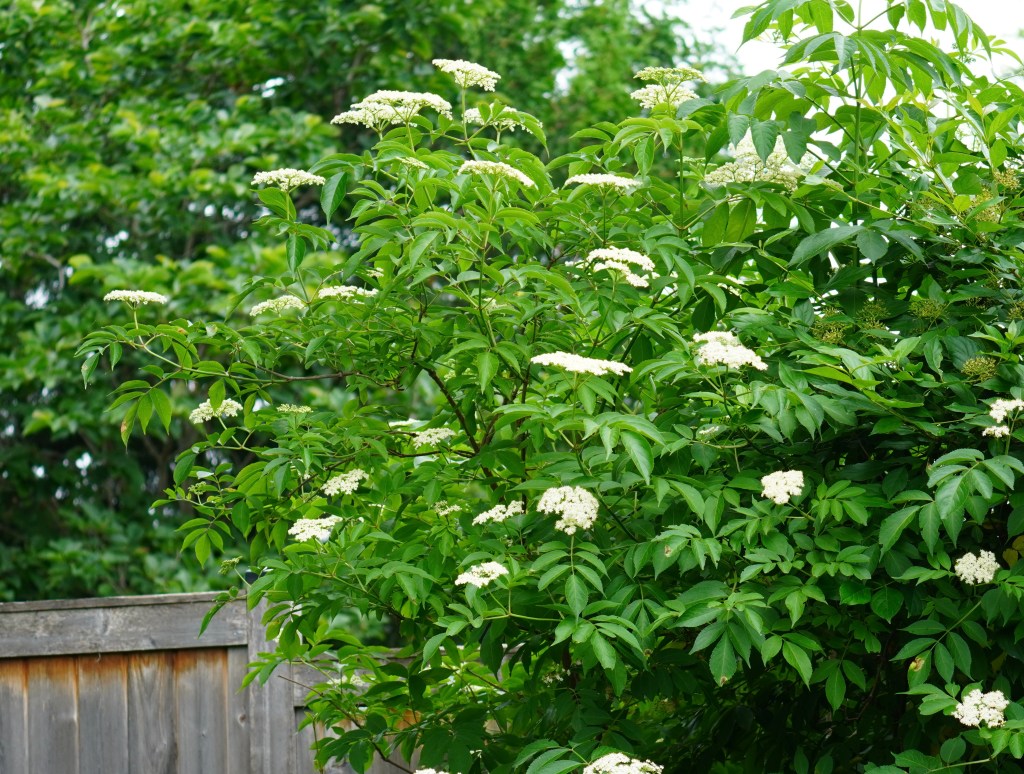


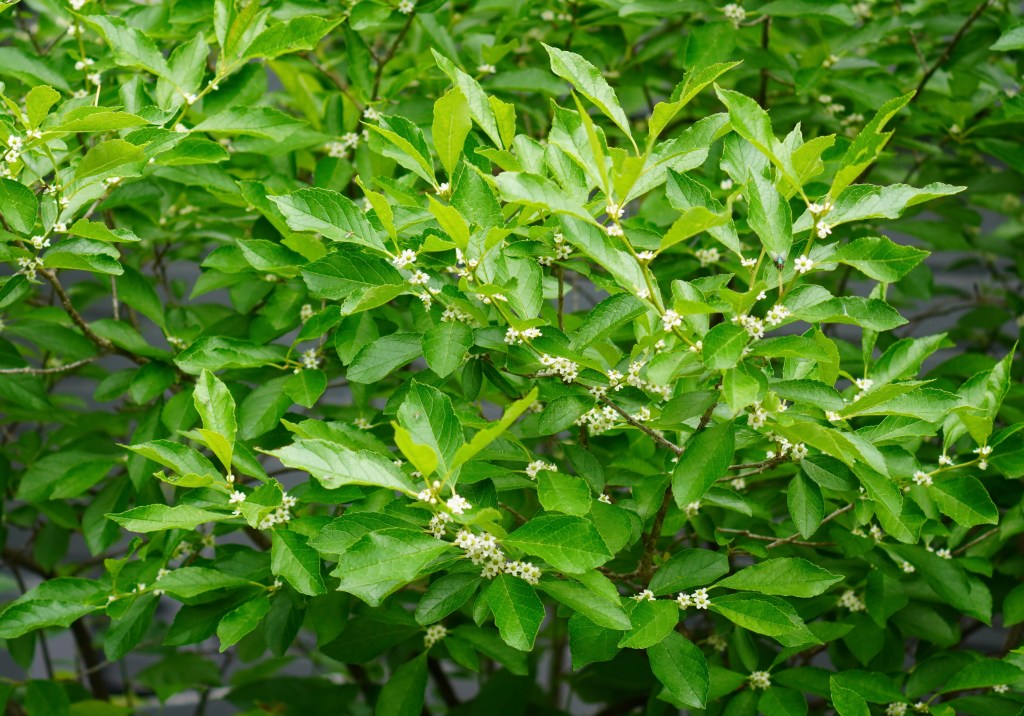

Photo 1: Black Elderberry (June 17, 2024); 2. Gray Dogwood (June 10, 2024); Smooth Rose (June 12, 2024); Winterberry (June 10, 2024); and Snowberry (June 12, 2024).
June 17 to 22: Purple Flowering Raspberry, Basswood, New Jersey Tea, Shrubby St. John’s Wort
Purple-flowering Raspberry canes, that rabbits didn’t eat during the winter, began to bloom in part-shade. They look like roses and similarly appealed to bumblebees. Several of the previous week’s shrubs also continued flowering.
Beyond the hedgerow, the Basswood tree was covered in fragrant white bells. In the garden beds, a few shorter shrubs began to bloom, namely New Jersey Tea and Shrubby St. John’s Wort.

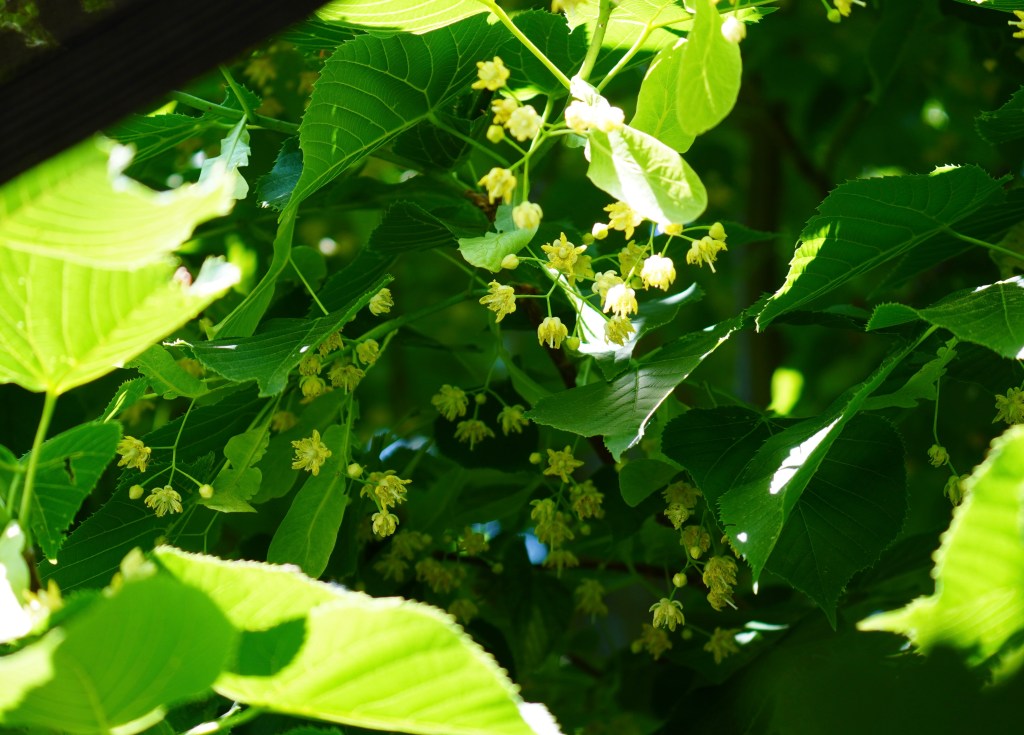
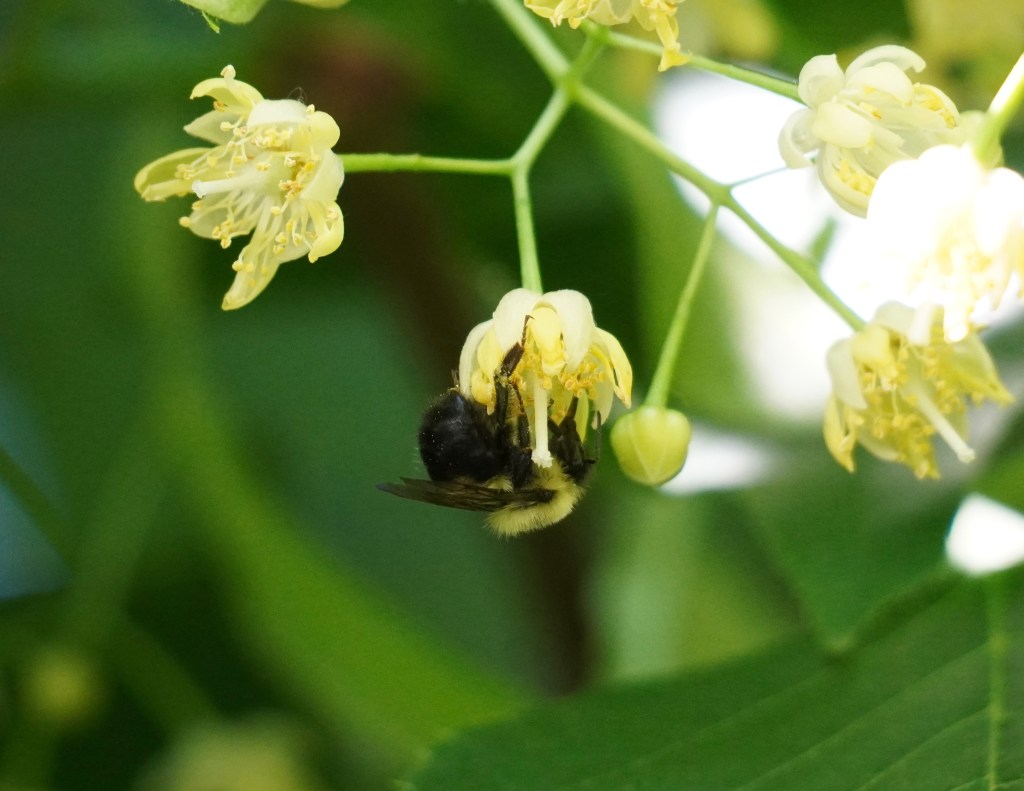
Photo 1: Purple-flowering Raspberry (June 17, 2024 ); 2 and 3: American Basswood (June 22, 2024);
Finally, that was it for hedgerow flowers. I was quite surprised the shrubs in my hedgerows continued blooming all the way to the beginning of summer.

 The Corner Pollinator Garden and Wildlife Habitat